

Hamnet Pissed Me Off
Surprise! It's the patriarchy, this time in a witch's clothing.

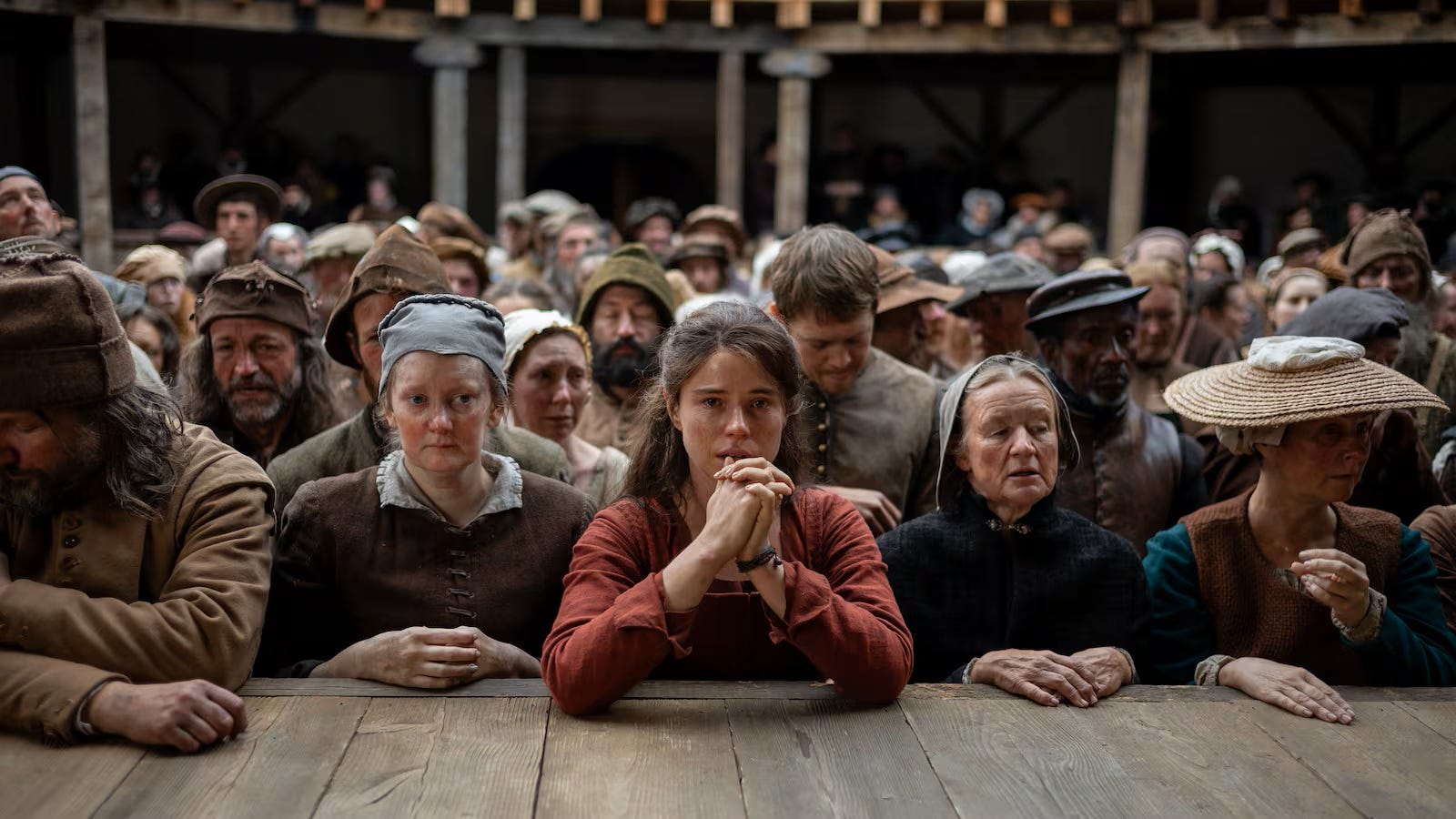
At first everything about the movie Hamnet charmed me. The witchy Agnes, the perfectly rendered children, the fact that Shakespeare himself was kind of ancillary. I laughed, I cried, I was under its spell completely, until the very last scene, at which point I lost my temper. Had I just sat through the most feminist-coded movie of the year, lauded and anticipated by women, written and directed by women, foamed over and frothed at by women, only to find out it actually disses the woman, and celebrates the man?
In the last scene, I watched Agnes, raw with grief and rage, standing in the dirt, chest pressed against the edge of the stage at the Globe Theater, silenced and literally placed beneath the male actors. I saw the story of her lost child play out in front of her — now revised by her husband into a father/son story, now transformed from screams of pain into structured poetry, now transported from a humble house in the country to a palace in a foreign land. And I was supposed to believe that in shutting up, listening, and being edified by this, somehow, she was transformed. That crushed on all sides by “the groundlings,” she had found herself. And that there, without another word or cry from her, the story should end. Well, I call bullshit.
Jessie Buckley’s Agnes is a character who sparkles with energy and wit and charm, dirty face notwithstanding, radical capsule wardrobe notwithstanding. The children are magically perfect, and I absolutely believed them on the screen. I was weepy as soon as the twins started running around together, watching their lives entwine, and knowing what was to come. With the father mostly absent, the mother is the center of the family, and Agnes is a powerful magnetic core. I loved this whole world. The attic beds, the grimy fingernails, the imaginary life of the children, Emily Watson’s mother-in-law character, the woods and the garden. The portrayal of the agony of grief, after Hamnet’s death, is heart-breaking and real. There are so many interesting notes, careful callbacks and delicate connections that give the movie such a lovingly crafted texture.
Shakespeare, the famous and important Shakespeare, is sidelined! He’s just “the son” and “the husband” and “the father.” But of course, he’s not entirely absent from the movie. He is, after all, also The Bard. This story’s version of Shakespeare is a tortured, driven poet, and only Agnes understands why he must go away from her and the children to London. She is the one who decides that he is too big for the small town life, and she helps create his identity as an artist. However, when tragedy strikes, and he’s not there, both of them realize the horror of his absence, and she blames him. She’s angry, and distant. She’s having trouble letting go of her grief, and accepting that her son is gone. Their love story is fractured.
Until she goes to London to be instructed by his holy and ineluctable iambic pentameter? After that, her son smiles at her, and goes into the woods. End of story.
Are you fucking kiddingme? She is Agnes, spellbinding and wonderful, rooted in the forest and the descendent of powerful, interesting women. She gave birth alone, inside a tree root. She is a savage, powerful tornado of femininity. And yet when she shuts the fuck up, and listens with the rest of the rabble, while her husband and “son” march around on a stage above her, saying the True Genius Words and doing the Very Important Art, there, squashed by milkmaids, up to the neck in stage, she learns from his example… how to grieve?
Female grief in this movie is raw and primal. Frenzied, unbound. It’s domestic, played out in the heart of the home, even literally on the hearth in one screaming, sobbing scene. Male grief, on the other hand, is represented here as public, and processed. Sublimated through art and poetry and history. Presentable for mass consumption. And apparently the lesson here, in the last scene of the movie, is that this version of the story, where Shakespeare is the dead father and Hamlet has lived as the son, is what opens Agnes’ eyes and heart. But she has been erased from this story! She is relegated down to the front row, to cry with all the strangers at the beautiful words. What?!
I get it: the power of theater. I understand it: collective catharsis. And I’ve had it explained to me that this moment at the theater was where she came to an understanding that he was suffering too. That she wasn’t alone in mourning. She came to an understanding of his grief. Well so fucking what? So she understands his grief — this is what releases her son into the woods? Please, explain it to me better. Because I’d love to believe that this feminist movie didn’t spend two hours creating a magical woman just to spend the last five minutes silencing and erasing her so that her famous husband could take center stage.
I hear you! Such a good point. To some extent, the movie was meant to follow the book, I suppose, but you are right that this issue seems even more problematic in the movie, perhaps because of Jessie Buckley's magnetism...
Sounds anticlimactic, probably won't watch.